
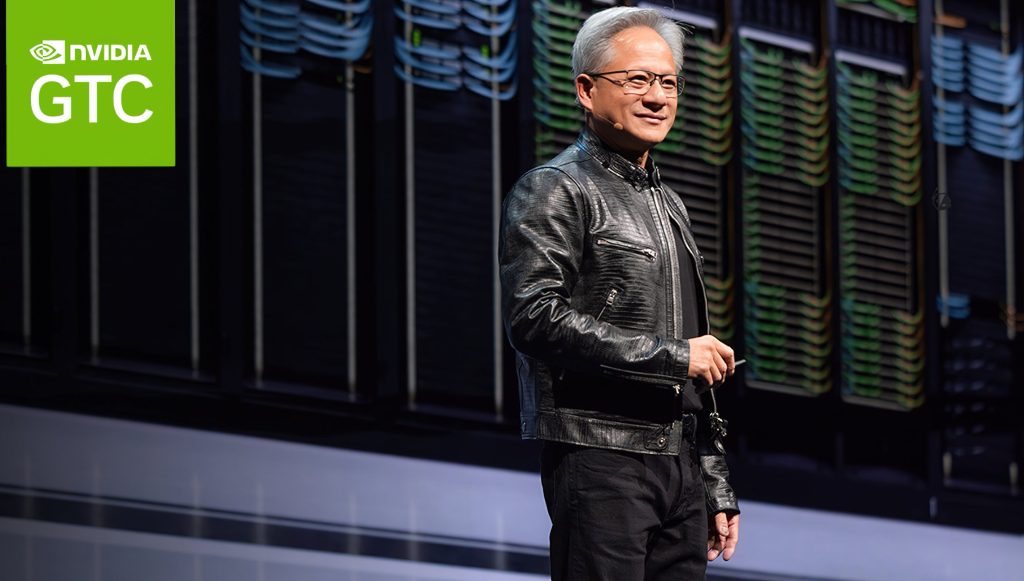
The Nvidia GTC 2025 conference, held in San Jose from March 17 to 21, solidified its role as one of the world’s most important gatherings for AI and high-performance computing. With over 25,000 in-person attendees and more than 300,000 participants online, this year’s GTC was larger in scope, deeper in content, and more focused on real-world applications than ever before.
More than just a showcase of technology, GTC 2025 positioned Nvidia as the architect of a future in which AI, robotics, simulation, and advanced computing are seamlessly integrated into every aspect of modern life – from enterprise operations and logistics to healthcare, urban infrastructure, and scientific research.
Major Announcements: Powering the Next Era of Intelligent Systems
The Blackwell Architecture: AI at Unprecedented Scale
The centerpiece of Jensen Huang’s keynote was the unveiling of Blackwell, Nvidia’s next-generation GPU architecture. Designed to handle trillion-parameter models with dramatically lower power usage and higher compute density, Blackwell represents a breakthrough in energy-efficient, large-scale AI training.
Blackwell is expected to power the next generation of foundational models across platforms like OpenAI, Anthropic, and Google DeepMind. Its key capabilities include:
- 25x faster inference for LLMs compared to the previous Hopper architecture
- 30% less power consumption for the same performance output
- Integration with Nvidia’s NVLink and NVSwitch for ultra-fast data communication between GPUs
This leap in performance and efficiency enables organizations to run enterprise-grade AI models that were previously cost-prohibitive, paving the way for mainstream adoption.
Project GR00T: Building Robots That Can Learn and Adapt
Another major highlight was the introduction of Project GR00T, Nvidia’s new foundation model for humanoid and embodied robotics. Unlike traditional rule-based automation, GR00T is designed to learn from human demonstrations and adapt to complex environments in real time.
In collaboration with companies like Boston Dynamics, Figure AI, and Sanctuary AI, Nvidia is making robotics:
- More general-purpose
- Emotionally responsive
- Capable of reasoning about their surroundings using vision-language models
GR00T has the potential to transform industries that rely on repetitive labor, warehouse logistics, elderly care, and even disaster response. The real breakthrough is in creating autonomous agents that can generalize knowledge across multiple tasks – something traditional robotics has struggled to achieve.
Omniverse Cloud: Expanding the Digital Twin Universe
Nvidia also expanded its Omniverse Cloud, a platform that enables real-time collaboration and simulation of photorealistic 3D environments. Built on OpenUSD and integrated with Nvidia’s physics and rendering engines, Omniverse helps enterprises:
- Simulate manufacturing lines, smart factories, and energy grids
- Design products collaboratively across geographies
- Create intelligent digital twins that learn and adapt with AI models
Industries like automotive, logistics, and heavy industry are using Omniverse to improve time-to-market, reduce design errors, and optimize energy use. In partnership with Siemens, BMW, and WPP, Nvidia is pushing digital twins beyond visualization and toward active AI-driven decision-making systems.
DGX Cloud: AI Infrastructure-as-a-Service
With the launch of additional DGX Cloud regions, Nvidia is making high-performance AI training infrastructure more accessible than ever. Enterprises no longer need to manage complex on-premise clusters; instead, they can tap into scalable GPU resources on demand through partners like Oracle Cloud, Microsoft Azure, and Google Cloud.
Key features of DGX Cloud include:
- Access to Nvidia AI Enterprise software stack
- Integrated tools for monitoring, orchestration, and model deployment
- Enterprise-grade security and data control
DGX Cloud is especially useful for enterprises in finance, healthcare, and R&D that require strict control over sensitive data while still benefiting from cloud-scale compute.
AI Trends Emerging from GTC 2025
Beyond product launches, GTC 2025 offered insights into how global enterprises are integrating AI into core operations.
Generative AI Goes Mainstream
No longer a novelty, generative AI is becoming embedded across industries. Use cases presented at GTC include:
- Legal firms automating document summaries
- Financial institutions generating market analysis
- Healthcare providers using generative models to assist in diagnostics and patient communication
What makes this shift significant is that generative AI is moving from pilots to production-scale systems, requiring robust governance, fine-tuning, and real-time monitoring.
Digital Twins Powered by Simulation and AI
Digital twins were a recurring theme across technical sessions. Companies are no longer using twins just for design, but also to simulate and optimize real-world operations continuously.
For example:
- Utilities are modeling energy demand and grid performance
- Manufacturers are testing production scenarios before actual deployment
- Cities are simulating traffic and public infrastructure to reduce emissions and improve safety
Nvidia’s Omniverse makes this possible by combining physical simulation, 3D rendering, and AI integration in real time.
Open Ecosystems and Responsible AI
Nvidia emphasized the importance of open development, supporting interoperability with platforms such as PyTorch, Hugging Face, and OpenUSD. The message was clear: AI must be transparent, explainable, and adaptable.
Workshops at GTC focused heavily on:
- Model auditing and version control
- Data provenance and lineage
- Secure collaboration in multi-tenant environments
Enterprises are demanding tools not just to build AI, but to govern and evolve it responsibly – a trend Nvidia is actively enabling.
Strategic Implications for Southeast Asia and Emerging Markets
For emerging economies like Vietnam, Indonesia, and Thailand – where digital transformation is accelerating yet still uneven, Nvidia GTC 2025 presents not just inspiration but also concrete models for AI adoption. While large global corporations are already deploying trillion-parameter models and full-stack digital twins, many Southeast Asian enterprises are still navigating early-stage modernization. Below are four strategic takeaways for regional leaders seeking to scale responsibly with AI.
Start with Cloud Infrastructure to Lower the Barrier of Entry
In many Southeast Asian markets, the lack of local access to high-performance computing infrastructure has traditionally slowed down AI innovation. Building and maintaining GPU clusters is expensive, both in capital and operational costs, especially for small to mid-sized enterprises.
With Nvidia’s DGX Cloud now available through major providers like AWS, Microsoft Azure, and Oracle Cloud, companies in the region can rent enterprise-grade compute power by the hour or project, eliminating the need for large up-front investment. This is a critical opportunity for:
- Fintech firms developing fraud detection or credit scoring models
- Retailers creating AI-driven recommendation engines
- Logistics companies optimizing route planning with real-time data
DGX Cloud ensures scalability and flexibility, enabling even non-tech-native businesses to enter the AI economy on demand.
Focus on Domain-Specific and Culturally Relevant AI Models
Pretrained large language models (LLMs) are powerful, but their performance tends to degrade in regional contexts where language, culture, and data behavior differ from the global norm. Southeast Asian languages such as Vietnamese, Thai, and Bahasa are still underrepresented in many global datasets, leading to poor model generalization and lower accuracy.
GTC 2025 showcased how enterprises can fine-tune foundational models with their own local datasets using Nvidia’s AI Enterprise suite. This allows organizations to build tailored AI applications that:
- Understand Vietnamese grammar, idioms, and tone
- Interpret local regulatory documents with accuracy
- Engage customers in natural, context-aware dialogue
Such domain customization not only increases performance but also enhances user trust and adoption. In sectors like government services, insurance, and education, this localization is critical.
Leverage Robotics and Digital Twins for Industrial Modernization
Vietnam and several ASEAN countries are at a strategic inflection point in industrial development. While low-cost manufacturing remains a strong economic pillar, there is growing pressure to move up the value chain with smarter, more automated and efficient production systems.
Technologies introduced at GTC 2025, such as Project GR00T for robotics and the Omniverse platform for digital twins, offer cost-effective paths to modernize operations without needing to rebuild from scratch. For example:
- A medium-sized furniture factory in Binh Duong could simulate its entire production line in Omniverse, identify bottlenecks, and test adjustments virtually before committing resources.
- An e-commerce fulfillment center in Indonesia could deploy general-purpose robots trained with GR00T to handle unpredictable object sorting or shelf restocking in dynamic warehouse environments.
These technologies reduce downtime, improve precision, and offer competitive advantage, especially as global buyers demand transparency, sustainability, and speed.
Prioritize Workforce Development and Industry-Academia Partnerships
While technology is rapidly advancing, human capital remains a major constraint in many emerging markets. There is an urgent need to close the skills gap in areas such as machine learning engineering, AI governance, data science, and model deployment.
Nvidia has responded to this need by expanding access to its Deep Learning Institute (DLI) and offering certified AI training pathways tailored to both developers and decision-makers. Regional governments, universities, and private enterprises should consider:
- Embedding AI fundamentals into STEM and business curricula
- Partnering with Nvidia’s education programs for instructor-led workshops
- Offering scholarships or employer-sponsored bootcamps for reskilling
GTC 2025 emphasized that AI literacy must extend beyond the IT department. Business strategists, marketing leads, operations managers, and public-sector officials must all understand how AI works, what it can and cannot do, and how to manage it responsibly.
Investing in people will be the key to sustainable AI transformation in Southeast Asia – ensuring that innovation does not leave talent behind.
Conclusion
Nvidia GTC 2025 demonstrated that artificial intelligence is not just a future vision – it is now the most powerful engine of enterprise transformation. With advancements in scalable infrastructure, generative AI, robotics, and digital twins, Nvidia is building the foundation for a smarter, more autonomous world.
The key takeaway for enterprise leaders is this: AI is no longer experimental. It is becoming operational. Organizations that prepare today – by investing in data infrastructure, embracing open systems, and reskilling their teams – will lead in the intelligent economy of tomorrow.
Whether you are in finance, healthcare, urban planning, or manufacturing, the path to innovation is becoming more accessible, more modular, and more immediate. Nvidia’s ecosystem is designed not only for big tech, but for every enterprise ready to scale with intelligence.