
Introduction
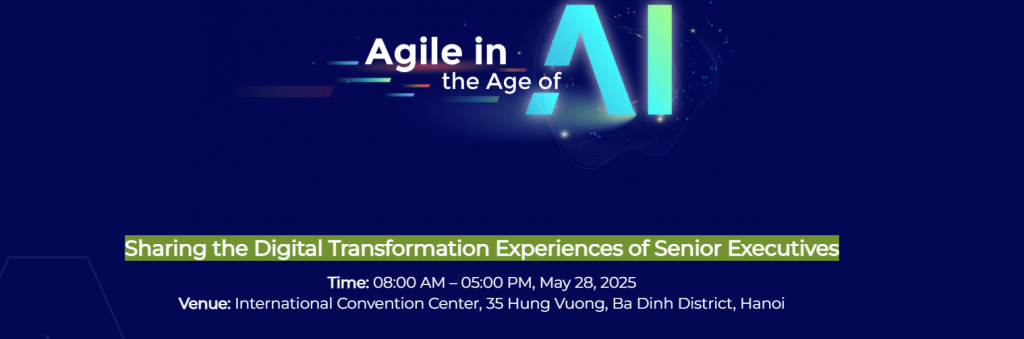
Agile Business Vietnam Summit 2025, held on June 8 in Ho Chi Minh City, brought together over 300 professionals, tech leaders, and business strategists to reflect on the role of agility in today’s dynamic landscape. The event, organized by Agile Vietnam and powered by a thriving community of change-makers, was more than a conference—it was a space for serious reflection on how Vietnamese organizations can navigate digital disruption and global competition through cultural transformation and adaptive leadership. In an era defined by unpredictability and accelerated innovation, agility is no longer a methodology, but a survival skill.
Why Agility Matters More Than
The summit emphasized that agility is no longer confined to software development teams or startups. Instead, it is emerging as a core competency for organizations aiming to thrive in uncertain and volatile markets. With artificial intelligence, consumer behavior shifts, and economic turbulence acting as constant disruptors, Vietnamese enterprises must become more responsive, iterative, and human-centered. True agility means moving fast without breaking purpose, empowering teams to learn continuously, and making bold decisions based on emerging signals rather than outdated plans. This is especially relevant as Vietnam aims to position itself not just as a manufacturing hub, but as an innovation-driven economy in Southeast Asia.
Key Insights from the Summit
The Shift toward Agile Leadership
A recurring theme across panels and workshops was the necessity of rethinking leadership. Traditional, hierarchical models rooted in control and predictability are proving ineffective in a world of constant change. Speakers shared that Agile leadership requires humility, emotional intelligence, and the ability to create environments where teams can self-organize and thrive. Organizations are now prioritizing the development of mid-level leaders who can guide through context, not command. Leadership agility – defined as the capacity to sense change, reframe challenges, and act swiftly – has become a critical differentiator in organizational performance.
Leveraging AI in Agile Ecosystems
Artificial intelligence was not positioned as a threat, but as a strategic partner. Throughout the summit, there was a strong consensus that AI should be integrated into Agile workflows not to replace human judgment, but to enhance decision-making, speed up feedback loops, and predict emerging needs. Examples included using machine learning to anticipate customer pain points or automating repetitive tasks to free up human creativity. However, experts cautioned that successful AI adoption depends on ethical alignment, data governance, and above all, clear leadership vision. The convergence of AI and agility offers enormous potential – but only for those ready to rethink how value is created and delivered.
3.3. Cultural Foundations for Organizational
Beyond tools and frameworks, agility is a function of culture. Several sessions explored how psychological safety, cross-functional collaboration, and learning mindsets are prerequisites for any Agile transformation. Agile cannot thrive in environments ruled by fear, bureaucracy, or rigid KPIs. Companies shared real-life barriers such as resistance to change, siloed thinking, and misaligned incentives. The summit advocated for intentional cultural redesign – shifting from blame to curiosity, from control to empowerment, and from fixed plans to dynamic sense-making. Without cultural readiness, Agile practices often become performative and fail to create long-term value.
Real – World Applications and Case Studies
The most impactful part of the summit came from real stories of transformation. Case studies from banks, retail chains, and tech companies demonstrated how agility is being scaled across product, marketing, and HR functions. One notable example was Techcombank’s internal agile center, which helped shift over 8 departments toward adaptive, iterative operations. Another case from a leading FMCG brand showcased how Agile marketing sprints led to faster go-to-market strategies and more personalized customer engagement. These stories were honest, including lessons learned from missteps and course corrections – offering valuable insights to peers navigating similar journeys.
What Lies Ahead for Vietnamese Enterprises
Agile Business Vietnam Summit 2025 did not merely celebrate agility; it challenged organizations to live it. The road ahead requires more than adopting tools – it calls for mindset shifts, leadership evolution, and culture-first strategies. In a world where change is exponential, those who wait for perfect conditions will fall behind. The summit closed with a resounding message: agility is not a trend – it is a strategic imperative. Vietnamese enterprises now have the opportunity to lead the region in building adaptive, purpose-driven, and AI-augmented organizations. The question is no longer “if” but “how fast” they can evolve.